
Waimea Racing Essentials & Technique Development Swim Camp (Ages 9-12), Kamuela, HI
Hawaii Preparatory Academy
65-1692 Kohala Mountain Rd ,
Kamuela,
HI 96743
Introducción
Fitter & Faster is producing a 2-day swim camp for competitive swimmers ages 9 to 12 focused on Essential Skills for Faster Racing.
If your swimmer is 13 years or older please click here.
Waimea, Hawaii Swim Camp (Ages 9 to 12):
Day 1 – Saturday, April 11
Session 1: Freestyle & Backstroke Technique
Session 2: Fast Starts, Underwaters, & Breakouts
Day 2 – Sunday, April 12
Session 3: Butterfly & Breaststroke Technique
Session 4: Flip Turns, Open Turns, & Finishes
Scroll down for details on the curriculum!
-> Sessions 2 and 4 will include swimmers ages 9 and over
✔️ Each session has limited availability to provide a focused, high-quality learning environment.
💡 SAVE when you purchase the "Entire Camp Bundle" for your swimmer's age group.
Session times:
Day 1:
Session 1: Check-in 8:15 AM, 8:30 AM-11 AM
Session 2: Check-in 11:30 AM, 11:45 AM-2:15 PM
Day 2:
Session 3: Check-in 8:15 AM, 8:30 AM-11 AM
Session 4: Check-in 11:30 AM, 11:45 AM-2:15 PM
Participantes sugeridos
Our top priority is to provide a world-class learning experience for all participants at all of our camps. This is registration page for ages 9-12. Click here for the page for swimmers 13 and older. Participants will range from one-year of competitive swimming experience to AAAA times and faster. If you are the parent of a swimmer under the age of 9 and would like for your swimmer to be considered for the younger sessions of this camp, please complete this questionnaire.
Plan de estudios
In this four-session swim camp, your swimmer will receive world-class guidance from elite clinicians at Fitter & Faster, focusing on key elements essential for enhancing overall racing performance! We understand that achieving peak performance demands ongoing refinement, which is why even the most elite swimmers are dedicated to perfecting the very skills we'll be honing with your athlete.
- Session 1: FREESTYLE & BACKSTROKE TECHNIQUE: Freestyle and backstroke share many fundamental skills, but they are performed very differently. In this session, swimmers will refine the key technical elements that make both strokes fast and efficient—while learning how bodyline, rotation, kick, and pull must be applied differently for each stroke.
- Bodyline: A strong bodyline is the foundation of both freestyle and backstroke. Swimmers will learn how to maintain a long, aligned posture in the water, engage their core, and eliminate extra movement that creates drag—whether swimming on the front or the back.
- Breathing: Freestyle requires coordinated breathing without disrupting body position, while backstroke allows swimmers to breathe naturally while maintaining rhythm. Participants will learn how to manage breathing and timing so both strokes stay balanced and efficient.
- Rotation: Both strokes rely on controlled rotation around the spine, but the timing and range are different. Swimmers will learn how rotation helps activate the core and back muscles, creating stronger pulls and more efficient movement in both freestyle and backstroke.
- Kicking: Freestyle and backstroke kicks both start from the hips, but they serve different purposes. Participants will work on generating steady propulsion, controlling tempo, and using ankle flexibility to create an efficient kick that supports speed and body position in each stroke.
- Pull: Power in both strokes comes from applying pressure to the water with the full arm and engaging the large muscles of the back. Swimmers will learn how the freestyle high-elbow catch compares to the wider pulling path used in backstroke, and how to generate power in both strokes.
- Continuous Motion: Freestyle and backstroke are both long-axis strokes that rely on rhythm and momentum. Swimmers will learn how to keep their arms moving smoothly and efficiently to maintain speed while maximizing distance per stroke.
- Session 2: STARTS, UNDERWATERS & BREAKOUTS: The better a swimmer’s technique is off the starting block, the more speed they will carry into the water. Day 1 of this swim camp will help your swimmer improve their start, underwater dolphin kicking and breakouts! This sequence is not only the fastest part of every race, but it is also the part of the race in which elite swimmers cover the most ground with the most efficiency.
- Block Starts: To ensure an explosive start, a swimmer needs to set themselves up properly on the block. The elite clinicians will work with participants on the optimal positioning of your swimmer’s entire body to allow for a quick reaction time and optimal speed.
- Water Entry: Starting the race with a smooth entry into the water will boost your swimmer's speed and carry the momentum generated off the block or wall. Becoming skilled at the water entry is crucial for any start and significantly contributes to your swimmers' overall race!
- Streamline: The streamline - when done properly - is the fastest a swimmer travels while in the water. Proper streamlines are even faster than underwater dolphin kicking. Even the most elite swimmers in the world are constantly working on improving their streamline. Your swimmer will get tips to improve their streamline and a better appreciation of what they need to do on every single wall in practice and in races.
- Initiating Underwater Dolphin Kicking: Top age group and elite swimmers maximize their streamline on every single lap. They don’t start their underwater dolphin kicking while they’re still achieving maximum speed in their streamline! They also don’t want to start the underwater dolphin kicking after their streamline has begun to slow. Your swimmer is going to learn how to time when to begin their underwater dolphin kicking.
- Powerful Underwater Dolphin Kicking: There are a few different techniques that swimmers use when underwater dolphin kicking. The common theme of these techniques is that the best swimmers kick up and down with equal power. We will show your swimmer the different techniques that elite swimmers use and teach them how to implement.
- Number of Underwater Dolphin Kicks: Figuring out the optimal number of kicks off each wall, for each race, is essential to fast swimming. Elite swimmers want to spend only the absolute necessary amount of time underwater to establish speed with each length. They want to avoid losing their breath and taking weak kicks.
- Breakouts: Many swimmers unintentionally add movements in their breakouts that reduce speed by creating drag. In this camp, participants will focus on perfecting their breakout timing to maintain momentum and power into each lap.
- Session 3: BUTTERFLY & BREASTSTOKE: On Day 2, your swimmer will apply the skills that we practiced on the first day of this camp to important segments of every sprint race, including the moment your swimmer pushes off the wall; breakouts; finishes and all out sprinting!
- Butterfly & Breaststroke Technique Development: We want your swimmer to establish a rhythmic butterfly & breaststroke. Today we will practice various drills and skills to help your swimmer develop flowing, explosive, high-riding hips and longer, more powerful strokes in butterfly & breaststroke.
- Bodyline: In both butterfly and breaststroke, speed starts with posture. Even the smallest changes in chin, neck, spine, or core engagement can dramatically affect efficiency. As swimmers grow and mature, body position shifts and habits form, so we’ll focus on maintaining alignment from head to hips, building a strong full-body connection that reduces drag, maximizes hydrodynamics, and creates faster, more powerful strokes—especially in the critical moments off the walls.
- Kick: In both butterfly and breaststroke, the kick is a major engine for speed. Swimmers will learn how to time two equally strong dolphin kicks per butterfly stroke to boost efficiency and rhythm, and how to build a powerful, well-sized breaststroke kick by keeping the ankles outside the knees and adjusting range based on flexibility. Small refinements in timing and kick size can unlock significant gains in speed and confidence.
- Pull: In both butterfly and breaststroke, an efficient pull keeps swimmers accelerating forward. We’ll focus on building an early vertical forearm and a complete, powerful finish in butterfly, while in breaststroke, maintaining high, forward elbows and a fast recovery to full extension. Swimmers will learn to match their pull width and tempo to their kick style, creating smoother bodyline, stronger propulsion, and faster, more fluid strokes.
- Breath & Timing: In both butterfly and breaststroke, precise timing is everything. We’ll focus on low, efficient breathing in butterfly that preserves bodyline and rhythm, and on refining breaststroke timing so the pull, kick, breath, and glide flow together seamlessly—creating a smoother, more powerful, and faster stroke cycle.
- Session 4: FLIP TURNS, OPEN TURNS & FINISHES: Quick, powerful turns and finishes are crucial to fast times and winning close races. The top age group and elite swimmers aren't using walls just for turning around - they are used to generate speed and momentum going into the next lap. Elite swimmers are constantly working their turns and looking for areas to improve them. Today, we're going to work with your swimmer on taking this crucial part of every race (and practice) to the next level!
- Momentum: At the elite level of swimming, walls aren’t just used for turning around - they are used to generate speed and momentum going into the next lap. Outside of the elite ranks, most swimmers stop or slow down while going into the wall, which kills their momentum! We will work with participants on the intricacies of approaching every wall at top speed and seamlessly initiating their “turn”.
- Flip Turns: The fastest swimmers use walls to generate speed and momentum going into the next lap. Outside of the elite ranks, many swimmers stop or slow down while going into the wall, which kills their momentum! We will work with participants on the intricacies of approaching every wall at top speed and seamlessly initiating their “turn”.
- Open Turns: Elite butterflyers and breaststrokers utilize speed from their last lap to create momentum and even more speed at the beginning of the next lap. Their open turns are actually not “turns”, but more like high-speed pivots. Participants in this session will work on these techniques to have much faster open turns!
- Streamline, Underwater Dolphin Kicking, Breakout Progression: At this session participants will continue to work on the progression covered on Day 1.
- Finishes: Setting yourself up for a fast finish is very similar to setting yourself up for a strong turn in any race. Races are won and lost by hundredths-of-a-second at every swim meet. Many races come down to the last few strokes. At this camp, your swimmer will learn techniques to set themselves up for a well-timed finish when they are still about 10 yards from the wall.
ASK QUESTIONS
Swimmers and parents are invited to ask the clinicians questions during a Q&A session. Gain insight into their training regimen, diet and nutrition, and recovery tactics.
WATCH THE CLINICIANS
Observe clinicians swim at full speed and demonstrate a progression of perfectly executed drills to achieve powerful, efficient and fast swimming.
PUT YOUR SKILLS TO THE TEST
Throughout the camp, swimmers will practice what they've learned with some of the world's most elite Swimmer Clinicians and coaches!
Take a photo, get autographs, and chat with your clinicians!
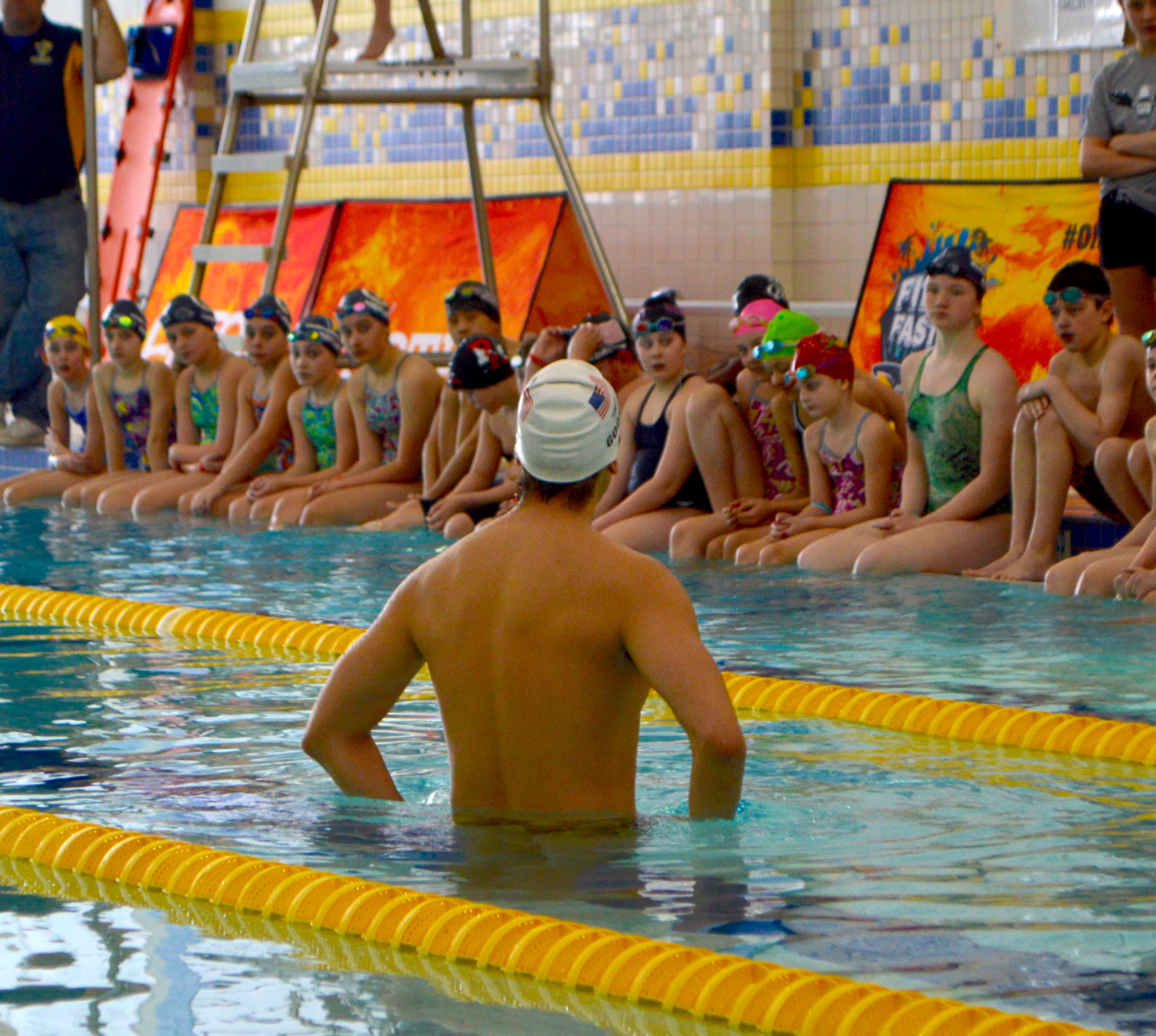
Elite Clinician
Fitter and Faster clinicians are Olympians and National Team members who have achieved at the highest level of the sport of swimming... and who have the unique skill to teach what they know from a technical perspective to swimmers of all ages and abilities.
Inquisitive, Educated Swimmers are Faster Swimmers! Sign up today!