
Austin, TX Swim Camp Series @ The Dell JCC (Ages 13 & Over), Austin, TX
Dell JCC
7300 Hart Ln,
Austin,
TX 78731
Introduction
Fitter & Faster is producing a series of swim camps for competitive swimmers ages 13 & Over at The Dell JCC in Austin, Texas, throughout 2026. Click here to view information for swimmers ages 10 to 12.
2026 Austin, TX Swim Camp Series
-> Comprehensive Breaststroke Racing (April 18-19)
-> Comprehensive Backstroke Racing (August 29-30)
🔽 Scroll down for details on the curriculum!
✔️ Each session has limited availability to provide a focused, high-quality learning environment.
💡 SAVE when you purchase the "Entire Camp Bundle" for your swimmer.
💲 Registration prices increase as the camps get closer. Purchase early before camps sell out.
🕘 Session Start Times (All Camps)
-> Check-in 8am | Camp 8:15am-11:15am
Participantes sugeridos
Our top priority is to provide a world-class learning experience for all participants at all of our camps. These camps have sessions for swimmers ages 13 & older. Participants will range from one-year of competitive swimming experience to AAAA times and faster.
Select a curriculum below


COMPREHENSIVE BREASTSTROKE RACING SWIM CAMP: April 18 & April 19, 2026
At the highest level of swimming, breaststroke has the most varied technique. Out of the eight finalists at the Olympic Games, you might see eight different styles of breaststroke! A swimmer's timing and ability to eliminate resistance are hallmarks of an efficient and powerful breaststroker. No matter your swimmer’s level, this 2-day camp will strengthen their technique, racing and training skills that will lead to faster and more efficient breaststroke races… and faster IM’s!
- BREASTSTROKE TECHNIQUE: Breaststroke is unique—no two swimmers look the same at the elite level. It’s all about reducing resistance, perfecting timing, and finding what works for each individual. We’ll build a foundation and then help each swimmer refine their style for maximum speed and efficiency. No matter your swimmer’s level, this session will strengthen their technique and lead to faster and more efficient breaststroke races… and faster IM’s!
- Check-in: 8 AM, Camp: 8:15 - 11:15 AM
- Bodyline: With the most drag of any stroke, breaststroke demands constant attention to body position. We’ll work on keeping the head, hips, and spine aligned and moving forward at every point in the stroke—especially during the crucial first strokes off each wall.
- Kick: A strong, powerful kick is key in breaststroke. In every breaststroke kick, the ankles should stay outside the knee. The optimal size of the kick varies by each swimmer and is highly dependent on knee and ankle flexibility. Swimmers who view themselves as “bad” at breaststroke kick often only need to focus on decreasing the size of their kick and they can unlock unknown potential.
- Pull: To have a great breaststroke pull, swimmers need to keep their elbows near the surface of the water and out in front of their shoulders at all times. Once the hands turn in and begin the “recovery” phase they need to move quickly to full extension in front of the body to reestablish bodyline. The pull pattern varies based on a swimmer’s kick. We’ll help swimmers match their pull width and tempo to their natural kick style—maximizing propulsion and efficiency.
- Timing: Elite breaststrokers are constantly tweaking their timing to achieve the ideal combination of power and efficiency. Our clinicians will introduce key drills that help connect the pull, kick, breath, and glide into a smooth, powerful cycle.
- BREASTSTROKE RACING & TRAINING SKILLS : On the first day of this camp swimmers worked on techniques to implement an efficient breaststroke. On Day 2 we will work on applying speed to their breaststroke! Our objective is to get your swimmer to maintain their technique with distance per stroke, tempo, and flowing speed.
- Check-in: 8 AM, Camp: 8:15 - 11:15 AM
- TEMPO: Tempo in breaststroke is the rate at which a swimmer can get back into the proper bodyline to establish a high-speed glide. When swimming breaststroke races, many athletes tend to take too many strokes without ever getting into the proper bodyline. At this camp we will explore different tempos that are sustainable for any distance and allow for the proper glide between strokes.
- DISTANCE PER STROKE: One way to increase efficiency is to take fewer strokes. Counting the number of strokes a swimmer takes per lap, while improving technique to decrease that number, will enable them to be more efficient and even conserve energy. At this session, participants will discover how changing speeds might change their stroke-count, but should not change the effectiveness of each stroke.
- PACING: A breaststroker’s pace is going to change during a race and from distance to distance. When swimming breaststroke, your swimmer can learn to measure their pace using tempo and distance per stroke. At this session we will practice race strategy pacing for all breaststroke events.
- BREASTSTROKE PULLOUTS: The breaststroke pullout is an important and unique part of every breaststroke race. We will work with participants on minimizing resistance in their pull-outs and establishing maximum speed. The pullout can be used strategically, depending on the distance of the race, to cover more ground before breaking out.
- TRAINING BREASTSTROKE: At the end of this session your swimmer will do a short and fast swim set to practice everything they have learned over the past two days.
COMPREHENSIVE BACKSTROKE RACING SWIM CAMP: August 29 & August 30, 2026
Over two days, your swimmer will work with Fitter & Faster's world-class clinicians to elevate their backstroke. They'll focus on refining bodyline, catch, kick, and pull for improved efficiency. They'll then explore strategies for tempo, stroke length, and efficiency to enhance their racing performance. Whether your swimmer is new to backstroke or looking to refine their technique, this camp offers valuable insights to help them progress in the pool.
- BACKSTROKE TECHNIQUE: While backstroke shares many concepts with freestyle, the actual skill can be much different. In this session, your swimmer will refine bodyline, rotation, kick, and pull specifically for backstroke.
- Check-in: 8 AM, Camp: 8:15 - 11:15 AM
- Bodyline: Backstroke bodyline should eliminate unnecessary movement. Even small amounts of bobbing or swaying create drag. Participants will learn to maintain a flat, aligned posture and engage the core to support a strong, stable position in the water.
- Rotation: Unlike freestyle, backstrokers rotate most fully onto their side when their hand is midway through the stroke. Rotation in backstroke is essential for two key reasons. First, to apply power during the pull, the swimmer’s hand must be positioned in front of the shoulder and at least a few inches below the surface of the water—something that’s only possible with proper body rotation. Second, rotation helps activate the large muscles of the back as the swimmer drives their hand through the surface and into the catch.
- Constant Motion: Unlike other strokes, backstroke has no built-in glide phase—the arms are always moving. Your swimmer will work on strategies to keep their stroke continuous and efficient, maximizing distance per stroke while maintaining tempo.
- Kicking: Effective backstroke kicking requires generating propulsion in both directions—both the forward and backwards motions. Your swimmer will learn to kick efficiently on their back, using ankle flexibility and consistent drive to support rotation and propulsion.
- Pull: Backstroke pull requires a high elbow catch, but also uses more of the full arm in the pull than any other stroke since the hand pulls much further outside the body line. We will work on feeling that full pull and engaging the large muscles of the back to generate power.
- BACKSTROKE RACING AND TRAINING SKILLS: On Day 1, participants practiced high performance backstroke techniques. Now, let’s leverage these skills to develop strong racing and training habits. Learning to prioritize tempo and length of stroke, while maintaining efficiency has a huge impact on maximizing speed in backstroke.
- Check-in: 8 AM, Camp: 8:15 - 11:15 AM
- Stroke Length: A long stroke will enable your swimmer to “catch” and hold onto more water to propel them as they swim. Whereas, a short stroke is inefficient and not sustainable for very long. The clinicians will work with participants on this important skill for fast swimming.
- Tempo: Tempo is the rate at which a swimmer is moving their arms and legs. When sprinting short races many swimmers often tend to take too many strokes (“spin their wheels”) and not “hold onto the water”. At this camp we will explore different tempos that suit your swimmer for their backstroke races.
- Pacing/Control: A swimmer’s tempo will change depending on the backstroke race that they are swimming. It may also change at different points during the same race! Your elite clinician will teach participants how to manipulate their tempo, speed and energy at different points in a race. This is called Pacing or “Control”.
- Backstroke Starts: The fastest part of every single race is the start - that’s no different for backstroke! Your swimmer is going to learn and practice starting a high performance backstroke race. We’re going to work on a “clean”, fast water entry in which the athlete carries the momentum from the start into their streamline, underwater dolphin kicking and breakout.
- Speed Set: At the end of this session your swimmer will do a short and fast swim set to practice everything they have learned over the past two days.
ASK QUESTIONS
Swimmers and parents are invited to ask the clinicians questions during a Q&A session. Gain insight into their training regimen, diet and nutrition, and recovery tactics.
WATCH THE CLINICIANS
Observe clinicians swim at full speed and demonstrate a progression of perfectly executed drills to achieve powerful, efficient and fast swimming.
PUT YOUR SKILLS TO THE TEST
Throughout the camp, swimmers will practice what they've learned with some of the world's most elite Swimmer Clinicians and coaches!
Take a photo, get autographs, and chat with your clinicians!
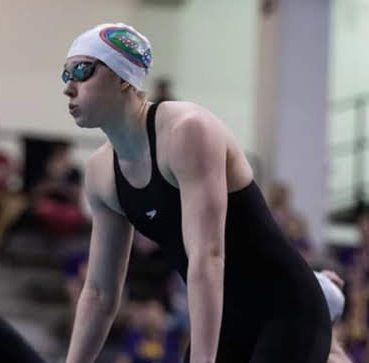
Gabrielle Hillis
Gabby Hillis combines her love for swimming and passion for working with young athletes in a career as a swim coach. She strives to help swimmers learn, grow, share, improve and enjoy what they are doing. She says, "Any positive impact I can make towards a swimmer’s success makes it all worth it!”.
Inquisitive, Educated Swimmers are Faster Swimmers! Sign up today!