
Snohomish Swim Camp Series (Ages 7 to 10), Snohomish, WA
SNOHOMISH AQUATIC CENTER
516 Maple Ave.,
Snohomish,
WA 98290
Introduction
Fitter & Faster is producing a series of 2-day Competitive Enrichment Swim Camps for swimmers ages 7 to 9 at the Snohomish Aquatic Center in Snohomish, Washington, in 2026! Our Competitive Enrichment Camps are engaging and transformative, designed to help young swimmers build foundational competitive skills, boost confidence, and develop a lifelong love for swimming.
2026 Snohomish, WA Competitive Enrichment Swim Camp Series
-> Freestyle & Backstroke Technique (April 11-12)
-> Butterfly & Breaststroke Technique (July 18-19)
-> Starts, Flip Turns, Open Turns, & Finishes (November 28-29)
🔽 Scroll down for details on the curriculum!
✔️ Each session has limited availability to provide a focused, high-quality learning environment.
💡 SAVE when you purchase the "Entire Camp Bundle" for your swimmer.
💲 Registration prices increase as the camps get closer. Purchase early before camps sell out.
🕘 Session Start Times (All Camps)
-> Check-in 9am | Camp 9:15-11:45am
Swim Camps for Other Age Groups in Snohomish, WA
Suggested Participants
Our top priority is to provide a world-class learning experience for all participants at all of our camps. This camp has sessions for swimmers ages 7 to 9. Participants will range from one-year of competitive swimming experience to AAAA times and faster. If you are the parent of a swimmer under the age of 7 and would like for your swimmer to be considered for the younger sessions of this camp, please complete this questionnaire.
Select a curriculum below


Freestyle & Backstroke Competitive Enrichment Swim Camp: April 11 & April 12, 2026
This camp is a great opportunity for young swimmers to build strong fundamentals, gain confidence, and improve their performance in a fun, supportive environment. With expert instruction and hands-on practice, swimmers will develop more efficient freestyle and backstroke technique - learning how to maintain strong habits, move more effectively through the water, and carry those improvements into their regular training and competition.
- FREESTYLE TECHNIQUE (Competitive Enrichment): Freestyle is the fastest, most efficient, and most widely used stroke in swimming. Because swimmers spend so much time practicing freestyle, it often develops a natural fluidity unmatched by other strokes. However, it also presents the risk of reinforcing bad habits, especially when swimmers are tired . Our elite clinicians will help your swimmer establish strong foundational habits and share strategies for maintaining an efficient stroke, even when pushing themselves in practice.
- Check-in: 9 AM, Camp: 9:15 - 11:45 AM
- BODY POSITION: A strong freestyle starts with an excellent "aquatic line," where the head, torso, hips, and feet align at the surface of the water. This streamlined position reduces resistance, making swimming both easier and faster. Maintaining this alignment is key to an effective and efficient freestyle stroke.
- BODY ROTATION: Proper rotation of the hips and shoulders together is crucial for generating and delivering power to the arms and hands. By incorporating the stronger back muscles into the pull, swimmers can achieve a more powerful stroke. Our clinicians will focus on teaching swimmers to rotate their hips and shoulders in unison, while establishing proper timing with their arm strokes.
- BREATH: A well-timed breath that works together with body rotation is essential to maintaining a strong aquatic line. Instead of lifting the head, which can cause the hips and feet to drop, swimmers should rotate their head at the neck and elevate their chin slightly while breathing. This minimizes unnecessary movements and keeps the body aligned. Our clinicians will work with your swimmer to develop a smooth, efficient breath that complements their stroke.
- KICK: A great flutter kick in freestyle relies on maintaining a small, fast, and consistent motion throughout the stroke. Each leg should function as an individual kick, even though both legs move simultaneously. Many young swimmers struggle with "scissor kicks," where the feet move out to the side during body rotation to stabilize the body. This disrupts the aquatic line, throws off timing, and significantly reduces efficiency and speed. Our clinicians will help your swimmer correct these habits and develop a propulsive, well-timed kick that enhances their freestyle.
- BACKSTROKE TECHNIQUE (Competitive Enrichment): Competitive backstroke presents unique challenges for young swimmers. As the only stroke performed on the back, it requires a different approach to body position and movement. Additionally, backstroke lacks a natural glide, with arms and legs in constant motion throughout the stroke. Our expert clinicians will help your swimmer develop greater comfort and efficiency in the water allowing them to swim backstroke both faster and longer.
- Check-in: 9 AM, Camp: 9:15 - 11:45 AM
- BODY POSITION: A great backstroke begins with a steady head aligned with the spine. Comfort on the back is crucial, supported by a tight core and a quick, steady kick. These elements elevate the hips and toes, allowing the swimmer to maintain a straight, streamlined body position on top of the water.
- BODY ROTATION: In backstroke, the hips and shoulders rotate together, enabling the swimmer to position their hand correctly for an efficient catch (the motion of the hand grabbing the water). At the highest point of recovery, the shoulder and hip should be at their maximum rotation. Young swimmers often struggle with body rotation and timing, leading to common mistakes like "crossover," where the hand enters the water behind the head, or placing the hand in the water rather than driving directly into the catch. Our clinicians will teach swimmers proper timing, fast hand entry, and how to engage a powerful catch at the top of their stroke.
- CONTINUOUS ARM MOTION: Backstroke requires continuous, alternating arm motion. A common error is pausing one arm at the waist, resulting in an inefficient "one-arm-at-a-time" stroke. We will help your swimmer master the skill of keeping their arms opposite each other and in constant motion.
- KICKING: Backstroke kicking should emphasize a whip-like, toe-driven motion, similar to kicking a soccer ball. However, being on their back often causes young swimmers to adopt a bicycle-like, knee-focused kick. Our clinicians will work with your swimmer to develop a compact, efficient, and propulsive kick that enhances their backstroke technique.
- LANE POSITION AND WALL APPROACH: With their head steady and eyes focused upward, many young swimmers struggle to maintain a straight lane position or confidently approach the wall. Our elite clinicians will share techniques to use visual cues, allowing swimmers to stay straight and accurately gauge the wall without turning or moving their head.
Butterfly & Breaststroke Competitive Enrichment Swim Camp: July 18 & July 19, 2026
This camp is a great opportunity for young swimmers to build confidence and develop strong technique in two of the sport’s most challenging strokes. With expert instruction and hands-on practice, swimmers will learn how to swim butterfly with greater efficiency and control, and refine their breaststroke into a more race-ready, competitive skill - helping them carry these improvements into their everyday training and competition.
- BUTTERFLY TECHNIQUE (Comptetitve Enrichment): Butterfly can be the most challenging stroke for younger swimmers due to its upper body demands and the difficulty in breaking the stroke into manageable drills. Teaching proper technique early, when strength is still developing, allows swimmers to build efficiency and confidence without relying on brute force. With instruction from our elite clinicians, your swimmer will learn a smooth, relaxed, and efficient Butterfly stroke that will serve them throughout their swimming career.
- Check-in: 9 AM, Camp: 9:15 - 11:45 AM
- BODY POSITION: Maintaining a streamlined body position is key in butterfly. Swimmers must keep their head low, chest pressing forward and down, and hips high to reduce drag. The three focus points below help young swimmers keep their bodies up on top of the water making it easier to maintain the proper rhythm.
- BODY UNDULATION: Butterfly relies on coordinated undulation (up and down movement) of the hips, shoulders and feet, which drives the arms through the water and helps move the head into position for breathing. Young swimmers often disrupt their timing when attempting to do two kicks during their stroke. While we want to add a second kick, establishing a single undulation for each stroke cycle is more important and should be tackled first.
- EARLY BREATH: Proper breath timing is crucial for maintaining an efficient body position in the water. Young swimmers often begin their breath too late, resulting in most of the breath occurring while their arms are out of the water during the recovery. With their head lifted and no arm support, their body tends to sink. To avoid this, the breath should begin as the swimmer initiates their pull, and by the time their arms exit the water, the head should already be moving back down. This timing allows the pull to support the body during the breath, keeping the hips high and reducing drag.
- ARM MOMENTUM: Butterfly can be a demanding stroke, but it offers an opportunity to pause and glide with the arms extended in front and the hips pressing upward. This brief pause helps swimmers move quickly through the back end of their stroke, generating momentum for the recovery while minimizing the time their head remains lifted out of the water. Our clinicians will work with your swimmer to eliminate any unnecessary pauses with their hands at their sides, promoting greater fluidity and consistent momentum throughout their stroke.
- BREASTSTROKE TECHNIQUE (Competitive Enrichment): Of all the strokes, competitive breaststroke differs the most from the foundational form taught to young swimmers. This makes it one of the most challenging techniques to master. Our elite clinicians are here to help your swimmer develop race-ready breaststroke skills!
- Check-in: 9 AM, Camp: 9:15 - 11:45 AM
- GLIDING: Competitive breaststrokers glide with their hands extended in front, reaching toward the far wall. They hold this extended position until and for several moments after the kick is completed. Maintaining a long, almost streamlined bodyline during the glide is key to maximizing efficiency and speed.
- HIGH HIPS: A fast breaststroke requires swimmers to keep their hips high in the water at all times. This involves minimizing the time their head stays out of the water. Swimmers will learn to initiate their breath early in the pull and avoid pausing with their hands near their chest—a critical step for maintaining momentum.
- KICK: The kick is the powerhouse of breaststroke. Swimmers will work on lifting their heels (instead of pulling their knees forward) and snapping their feet quickly around and back to generate strong propulsion. Emphasis will be placed on maintaining the kick within the same horizontal plane and rotating the ankles throughout the motion to develop a powerful and legal kick. Our clinicians will guide participants in refining and strengthening their kick to achieve maximum forward momentum.
- PULL: The key to breaststroke is generating propulsion with the pull while minimizing resistance—and quickly returning to a straight bodyline for a high-speed glide. Many young swimmers have too big of an armstroke which impacts their timing and can even lead to disqualification. Swimmers in this clinic will learn to establish a proper "catch," keeping their hands and elbows high in the water and in front of their shoulders throughout the pull. These techniques will help them maintain forward momentum and achieve their fastest breaststroke.
Starts & Turns Competitive Enrichment Swim Camp: November 28 & November 29, 2026
This camp is a great opportunity for young swimmers to take the next step from learning strokes to racing with confidence. With expert instruction and hands-on practice, swimmers will develop stronger, more efficient starts, turns, and finishes - helping them carry speed through every part of the race and gain a competitive edge when it matters most.
- GOING FROM DIVES TO STARTS (Competitive Enrichment): Transitioning to competitive swimming involves mastering racing starts from the blocks. This Competitive Enrichment clinic is designed to help swimmers elevate their skills by building confidence and transitioning from basic dives to powerful racing starts. Participants will focus on improving their starts, underwater dolphin kicks, and breakouts—the fastest and most efficient part of any race.
- Check-in: 9 AM, Camp: 9:15 - 11:45 AM
- BLOCK STARTS: Confidence on the blocks begins with proper setup. Our elite clinicians will teach swimmers how to position their bodies for a stable base, allowing them to remain steady while poised to launch into their start at the sound of the horn.
- WATER ENTRY: A smooth, shallow entry into the water is key to carrying momentum from the blocks into the race. This session emphasizes improving water entry, a crucial skill for maximizing speed and efficiency right from the start.
- STREAMLINE: A proper streamline is the fastest a swimmer can move in the water. Even elite swimmers continually refine this technique. Participants will receive tips to improve their streamline, helping them maximize speed off starts and on every wall during practice and competition.
- POWERFUL UNDERWATER DOLPHIN KICKS: Underwater dolphin kicking is a vital skill, with the best swimmers generating equal power on the up and down kicks. Our clinicians will introduce different techniques used by elite swimmers and teach participants how to leverage them for faster starts and walls.
- BREAKOUTS: Breakouts are often a trouble spot, with many swimmers inadvertently creating drag through unnecessary movements. This session will focus on refining breakout timing to maintain momentum and power into each lap.
- FLIP TURNS, OPEN TURNS & FINISHES (Competitive Enrichment): For developing competitive swimmers, mastering turns and finishes is a critical step toward transitioning from simply swimming to racing. While proper turn technique is vital, the process begins well before reaching the wall and the impact of a great push off will carry speed through the next length. Similarly, a well-executed finish can make the difference in close races, with the preparation for a great finish beginning far before the final touch.
- Check-in: 9 AM, Camp: 9:15 - 11:45 AM
- FLIP TURNS: Racing flip turns require precise technique. Swimmers must drop their head quickly without pausing, keep their hands narrow during the rotation, and finish with foot placement and body position that allow for a powerful push-off. Our clinicians will teach swimmers how to turn for maximum speed and efficiency.
- OPEN TURNS: Open turns often require swimmers to re-learn technique. Instead of turning to the side, swimmers will practice bringing their knees and feet straight to the wall, almost like a backflip. They’ll also learn to stay low in the water and use smooth arm movements that lead to optimal foot placement and streamlined push-offs.
- MOMENTUM OFF THE WALL: The push-off is the fastest part of each length, and carrying that speed into swimming strokes is essential. This clinic will teach proper push-off positioning and tight streamlines to maintain speed.
- MAINTAINING SPEED: One key to both great turns and finishes is maintaining or even increasing speed in the final five yards. Swimmers will develop the habit of “swimming through the wall,” ensuring they carry speed from the flags to the wall and come out ahead in races.
- FINISHES: Strong finishes involve eliminating breaths inside the flags, maintaining stroke length and speed, and touching the wall with force just below the surface. Our clinicians will help swimmers build these habits to consistently deliver competitive finishes.
ASK QUESTIONS
Swimmers and parents are invited to ask the clinicians questions during a Q&A session. Gain insight into their training regimen, diet and nutrition, and recovery tactics.
WATCH THE CLINICIANS
Observe clinicians swim at full speed and demonstrate a progression of perfectly executed drills to achieve powerful, efficient and fast swimming.
PUT YOUR SKILLS TO THE TEST
Throughout the camp, swimmers will practice what they've learned with some of the world's most elite Swimmer Clinicians and coaches!
Take a photo, get autographs, and chat with your clinicians!
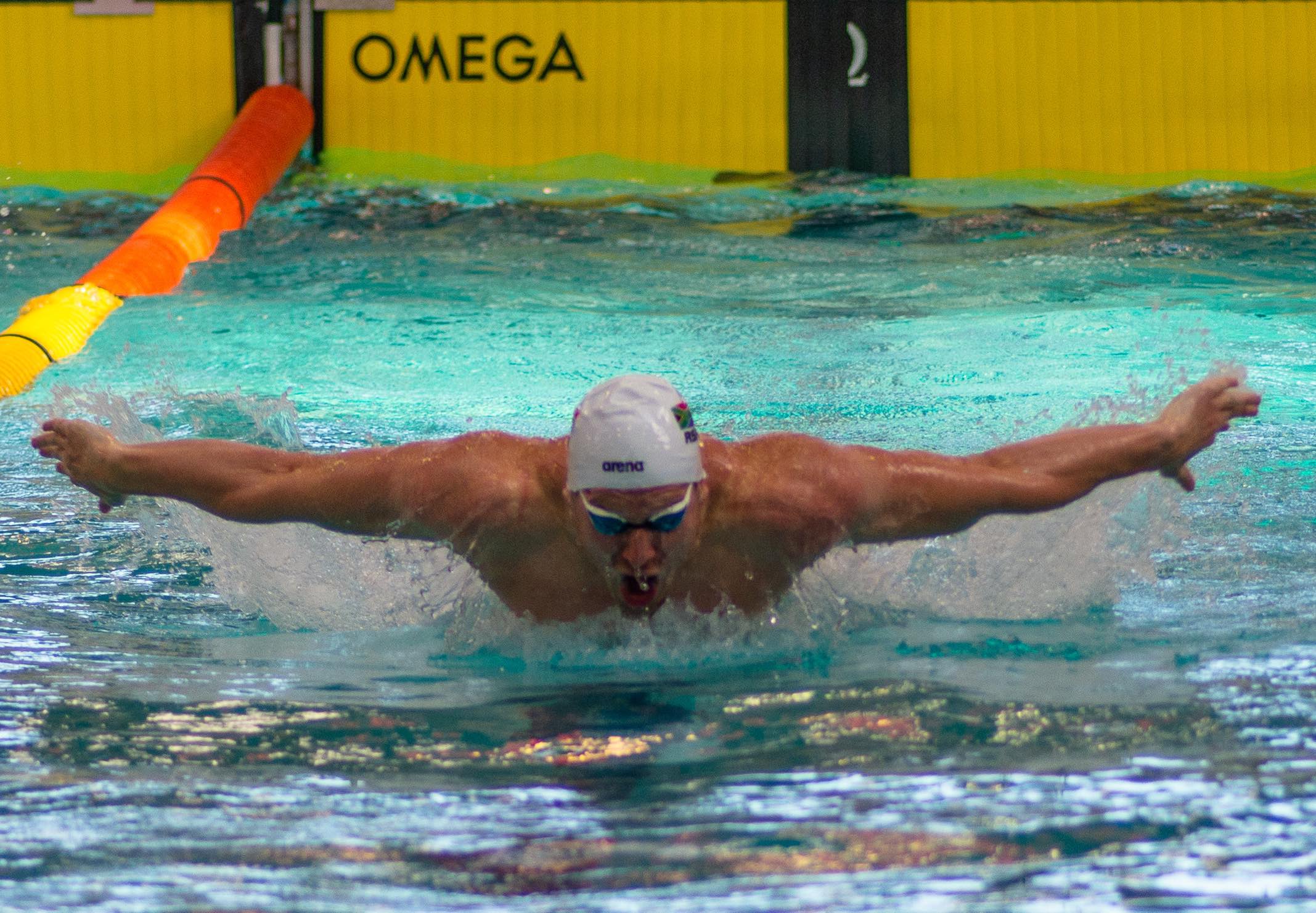
Ryan Coetzee
Ryan Coetzee maintains a focused learning environment for Fitter & Faster Swim Camp participants by setting clear boundaries to allow the swimmers to have fun and improve their skills. “Kids are at the camps to get something they’re not getting in their regular practice, and I want to ensure they leave with something.”
Inquisitive, Educated Swimmers are Faster Swimmers! Sign up today!